PE Core
Polyethylene core
Lightweight, economical, easy to fabricate, but combustible and restricted in many facade applications.

ACP core type is the most important hidden part of an aluminium composite panel. The outside of two panels may look identical, but the core inside can completely change the panel’s fire behaviour, weight, rigidity, fabrication, approval status, and suitability for facade use.
This guide explains the main ACP core types: PE core, FR core, A2 core, and A1-direction aluminium composite panels. It also explains why core percentage, mineral loading, fire classification, test reports, and complete facade system testing matter more than marketing names.
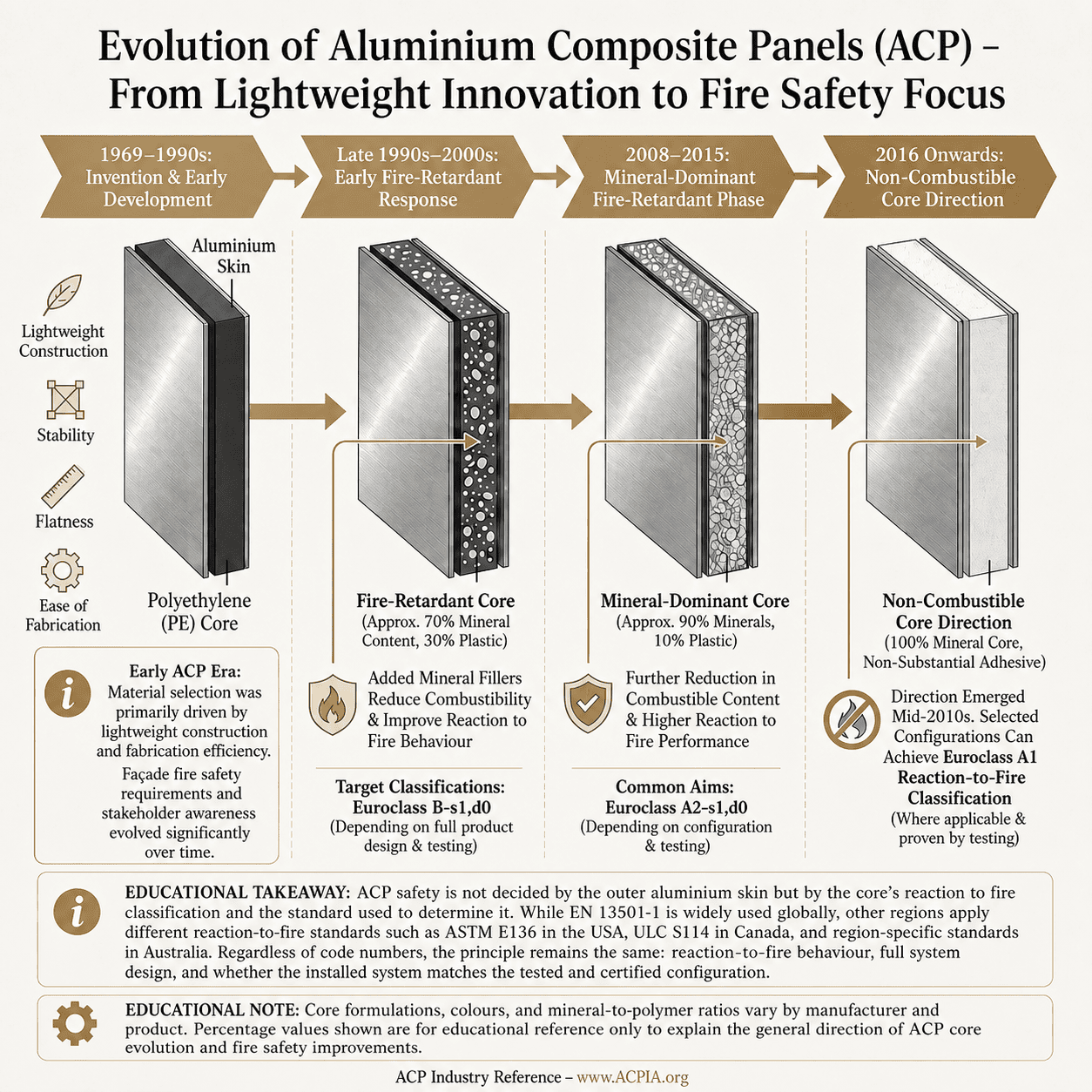
PE core ACP is polymer-rich, lightweight, easy to fabricate, and combustible. FR core ACP contains mineral fillers to reduce combustibility compared with PE. A2 core ACP contains very high mineral content and targets stronger reaction-to-fire classification. A1-direction ACP pushes the technology further toward non-combustible performance with very low organic contribution. Combustibility is a material property; the real risk occurs when a core type is selected for an unsuitable application. The correct core must be selected according to building use, height, local fire code, test evidence, authority acceptance and complete facade system design.
Combustible materials exist in many parts of the built environment. The issue is not the existence of a combustible material by itself; the issue is whether that material is selected, specified, approved and installed in an application where its fire behaviour is suitable and permitted. ACP core selection is therefore a stakeholder responsibility involving the developer, consultant, contractor, fabricator, supplier, authority and installer.
The core of an ACP is the central layer between the front and rear aluminium skins. It gives the panel thickness, contributes to rigidity, affects weight, influences fabrication behaviour, and strongly controls fire performance.
In simple terms, the aluminium skins give the panel its metal surface, while the core decides much of the internal behaviour. This is why ACP should never be judged only by colour, coating, or total thickness.
ACP core type means the material formulation inside the aluminium composite panel, such as PE, FR, A2, or A1-direction core technology.
For full layer explanation, read ACP Anatomy Explained.
Lightweight, economical, easy to fabricate, but combustible and restricted in many facade applications.
Mineral-filled core designed to reduce combustibility and improve fire behaviour compared with PE core.
Higher fire-performance direction using very high mineral content and limited organic binder.
Advanced core technology direction targeting very low combustibility and A1 classification where independently proven.
| Core type | Typical composition direction | Fire behaviour direction | Common use caution |
|---|---|---|---|
| PE Core ACP | Polyethylene-rich core | Combustible | Generally not suitable for regulated high-rise facade applications. |
| FR Core ACP | Polymer binder with mineral filler | Improved fire behaviour compared with PE | Actual performance depends on mineral content, formulation, and testing. |
| A2 Core ACP | Very high mineral content with limited binder | High reaction-to-fire performance direction | Must be verified by valid A2 classification and project acceptance. |
| A1 Direction ACP | Highly mineral or non-combustible direction with very low organic contribution | Advanced non-combustible performance direction | Requires strong independent testing, manufacturing control, and clear field of application. |
Core type must be selected with ACP Fire Safety, NFPA 285, and local regulation in mind.
PE core ACP uses a polyethylene-rich core between aluminium skins. It helped ACP become popular because it is lightweight, economical, easy to fabricate, and suitable for many signage, interior, and low-risk applications.
The major limitation is fire behaviour. PE core is combustible and can contribute fuel in fire. For this reason, PE core ACP is restricted, prohibited, or unsuitable for many regulated exterior facade applications, especially high-rise cladding.
PE core ACP can be suitable for permitted low-risk uses such as signage or interiors where allowed, but it should not be selected for regulated facade use without checking local fire code, building height, occupancy, authority requirements, and complete wall system safety.
FR core ACP contains mineral fillers and fire-retardant components designed to reduce combustibility compared with PE core. It represents an important step in ACP evolution because it moves the panel away from purely polymer-rich core behaviour.
However, FR is not one fixed universal formula. Different manufacturers may use different mineral percentages, binders, additives, and processing methods. Therefore, FR core ACP must be judged by valid fire classification, test reports, certification, and production consistency.
A2 core ACP is a higher fire-performance aluminium composite panel direction. It normally uses very high mineral content with limited organic binder, aiming to achieve A2 reaction-to-fire classification under relevant standards.
A2 core technology is more difficult to manufacture than PE core because high mineral loading affects compounding, extrusion, bonding, flexibility, weight, routing, and folding behaviour. This is why A2 ACP requires stronger process control and proper test evidence.
A2 classification must be proven by valid test reports. Do not accept “A2 type” or “A2 grade” marketing language without independent classification evidence and project-specific acceptance.
A1-direction ACP is the advanced edge of aluminium composite panel core technology. It aims toward non-combustible performance by using highly mineral or non-combustible core systems with very low organic contribution.
A1-direction ACP is technically challenging because the product must balance fire performance, bonding, lamination, panel flatness, fabrication behaviour, weight, and long-term durability. The more mineral and less organic binder inside the core, the more important manufacturing discipline becomes.
A1-direction ACP should not be treated as a slogan. It must be treated as a tested, documented, and controlled technology.
Core names such as PE, FR, A2, and A1-direction are useful, but fire classification must come from testing. A product should not be approved only because the name sounds safe. The test report must identify the exact panel, core, thickness, aluminium skin, standard, laboratory, and result.
| Claim | What to ask | Why it matters |
|---|---|---|
| FR ACP | Which fire classification and which test report? | FR is not a universal fixed performance level. |
| A2 ACP | Is there a valid A2-s1,d0 or applicable classification report? | A2 must be proven by testing, not claimed by name. |
| A1 ACP | Which independent lab classified it as A1 and under which standard? | A1 is a very strict claim and needs strong evidence. |
| NFPA 285 compliant | Which complete wall assembly was tested? | NFPA 285 is an assembly test, not a panel-only label. |
Read Fire Testing Standards for test comparison.
Core type affects more than fire safety. It also affects weight, cutting, routing, folding, bending, cassette returns, drilling, handling, and installation. Higher mineral cores are usually heavier and may require more careful fabrication than PE core panels.
| Core type | Weight direction | Fabrication behaviour |
|---|---|---|
| PE Core ACP | Usually lighter | Easy to route, fold, and bend. |
| FR Core ACP | Moderate to heavier than PE | Depends on mineral loading and formulation. |
| A2 Core ACP | Usually heavier | Requires careful routing, folding, and handling. |
| A1 Direction ACP | Often heavier advanced direction | Requires manufacturer-specific fabrication guidance. |
Read ACP Weight Guide and ACP Thickness Guide.
| Application | Core selection direction | Important approval point |
|---|---|---|
| Interior decoration | PE, FR, or higher grades depending on code and occupancy. | Check internal fire requirements and smoke limitations. |
| Signage | PE or FR commonly used depending on location and exposure. | Outdoor signs must consider wind, weather, and local fire rules. |
| Low-rise facade | FR, A2, or A1-direction depending on local code and project risk. | Do not assume low-rise means no fire requirement. |
| High-rise facade | A2 or A1-direction commonly preferred where regulation is strict. | Full system testing and authority approval may be required. |
| Canopy and soffit | FR, A2, or A1-direction depending on location and fire exposure risk. | Overhead applications require careful fixing and fire review. |
For use cases, read ACP Applications.
Buyers and consultants should not approve ACP core type based only on brochure wording. The core must be verified through test documents, technical data, production traceability, and project-specific compliance.
For buyer guidance, read ACP Procurement Guide.
FR performance varies by mineral content, binder, formulation, manufacturing, and test classification.
A2 must be proven by valid reaction-to-fire classification, not only marketing wording.
A strong core does not remove the need for facade assembly testing where required by code.
Cheaper cores may not meet fire, weight, bonding, or long-term facade requirements.
ACP core type should be selected according to building use, height, facade system, local code, fire testing, authority approval, coating requirement, fabrication method, and long-term performance need. The purpose of core classification is not to blame earlier technologies, but to ensure each material is used only where it is suitable, compliant and supported by evidence.
Do not select ACP core type by colour, price, sample appearance, or verbal claim. Select it by tested classification, core composition, project regulation, complete facade assembly, and responsible documentation.
The main ACP core types are PE core, FR core, A2 core, and A1-direction core technology. Each has different fire behaviour, weight, fabrication, and application suitability.
PE core ACP uses a polyethylene-rich core. It is lightweight and easy to fabricate, but combustible and restricted in many facade applications.
FR core ACP contains mineral fillers and fire-retardant components designed to improve fire behaviour compared with PE core ACP.
A2 core ACP uses very high mineral content and limited organic binder to achieve stronger reaction-to-fire performance under relevant classification standards.
A1 ACP refers to an advanced non-combustible direction of aluminium composite panel technology where the product aims for A1 classification through very low combustible contribution and independent testing.
Not automatically. FR means fire-retardant, not necessarily non-combustible. The actual fire performance must be verified through valid test reports.
A2 ACP generally represents a stronger fire-performance direction than standard FR ACP, but the actual product must be verified by classification reports and project approval.
Yes. PE core ACP is usually lighter, while FR, A2, and A1-direction cores are usually heavier because of higher mineral content.
Yes. Higher mineral cores can be heavier and may require more careful routing, folding, cutting, and handling than PE core panels.
High-rise facades usually require fire-rated core technologies such as A2 or A1-direction systems depending on local code, authority approval, and complete facade system testing.
Understand fire classification, core risk, system testing, and facade safety.
OpenCompare reaction-to-fire, combustibility, and full facade assembly tests.
OpenLearn how PE, FR, A2, and A1-direction cores affect ACP weight.
OpenKnow what documents to verify before specifying or buying ACP.
Open